Moarticlest elegant watches for men and women
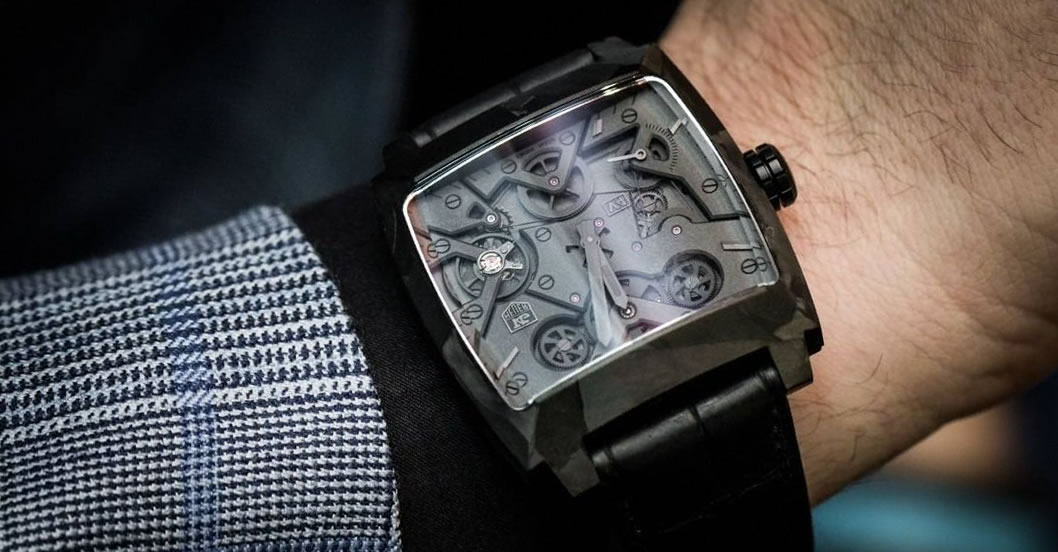
TAG Heuer Monaco V4
The Monaco V4 was first introduced in 2004 by TAG Heuer and during the time, many were doubtful with the reliability of the innovative belt-drive movement. It took the company 5 years to finally bring the Monaco V4 into the market and it turns out that perfecting it was only a training exercise for bigger and better projects from the company.
TAG Heuer launched the Monaco V4 Tourbillon at Baselworld and Guy Semon, the fighter pilot who became a physicist announced that this new version is not just a concept watch but a fully operational product that will serve as a platform for future creations.
The tourbillon is belt driven and the power delivery system is just like what's in the original V4 however it has been modified. The 4 transmission belts have a diameter of .07mm thinner than a piece of paper. According to TAG Heuer, this system gets rid of the backlash linked to the wheel-and-pinion designs which enables the tourbillon to operate a lot smoothly than ever. It also has the linera-mass winding system from the original V4.
The movement of the Tourbillon is encased in a 41mm case with a square shape. It is polished in grade 5 titanium and a carbide coating in black.
The design of the Monaco V4 Tourbillon was made in-house. It was also assembled at the haute horlogerie workshops of TAG located in La Chaux-de-Fonds. There are only 50 units of this limited edition watch priced at $165,000.
Omega Seamaster Ploprof
When the Omega Ploprof 1200M was introduced several years ago in 2009, I was pleasantly surprised to see the wonderful job they did. The resemblance with the original Ploprof 600M 166.077 was impressive. The new Omega Seamaster PloProf 1200M looked very much like the PloProf 600M version from 4 decades earlier.
History In A Nutshell
For a more comprehensive history of the Omega Seamaster Ploprof 600 check out Jon Wallis' article Omega Ploprof's History. I will mention the highlights of the PloProf history here, mainly based on Omega's documentation.
According to the official documentation, it took Omega over 4 years to come up with a solution to create a watch that could deal with extreme pressure to withstand the pressure when diving in great depths. They even involved some COMEX divers in the testing the prototypes of Ploprof during the Janus operation in 1970. Omega was experimenting with different kinds of watch materials including titanium. Less then 10 pieces were made from titanium for testing purposes, but they didn't make it to production since the price for this kind of watch would have been very expensive.
Finally, Omega came up with this solution: a monobloc stainless steel case with a locking bolt to secure the crown. At extreme depths divers would be dealing with a pressurized chamber where they breathe not just oxygen but also helium. The helium gas will penetrate the watch under pressure, but you probably know this if you're fond of divers watches. Omega also wanted to measure the Ploprof 600M's maximum pressure which showed that the watch will fail upon reaching 1370 meters (or 137 ATM) wherein the seconds hand stopped because of crystal and case deformation. The Ploprof 600M began production in 1970.